

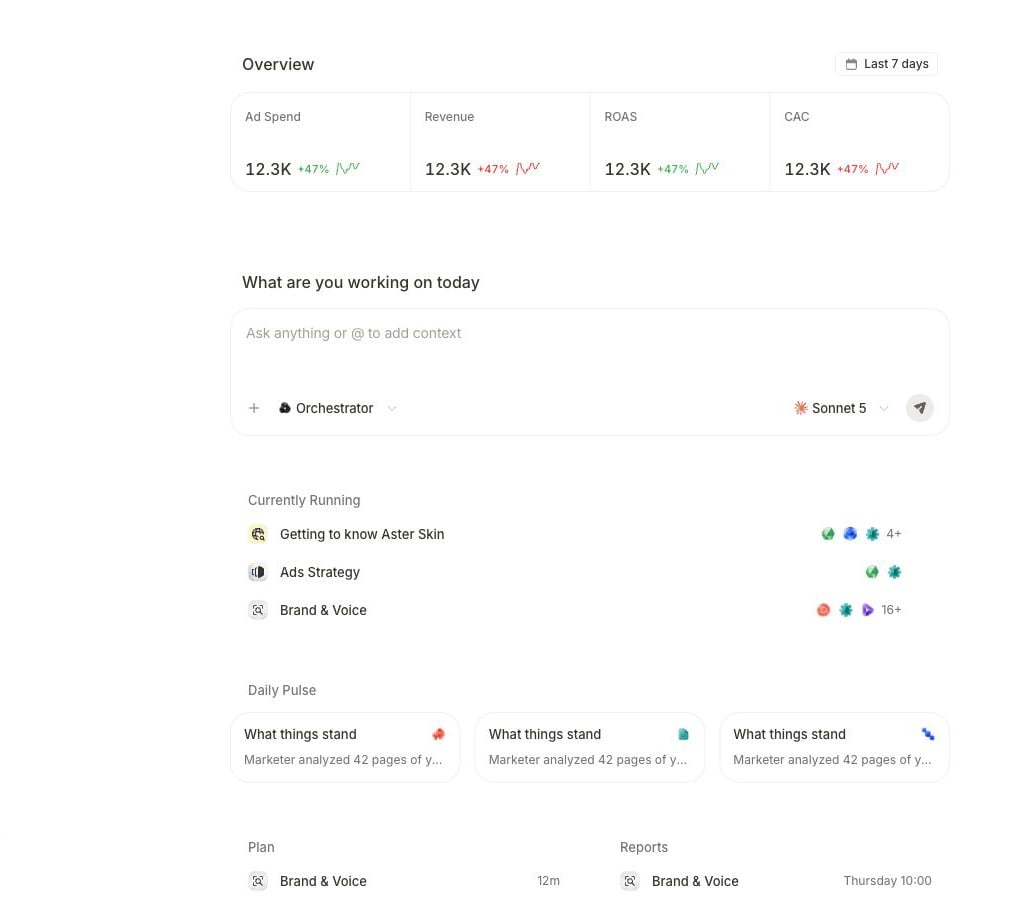
Home combines the workspace overview, request composer, currently running work, Daily Pulse, plans, and reports.
Read Home before you send
Use the page from top to bottom:- Confirm the active workspace in the workspace selector.
- Check the Overview timeframe when your request refers to a number visible on Home.
- Look under Currently Running for work that may already answer the request.
- Review Daily Pulse, Plan, or Reports when the request continues from one of those outputs.
- Start the new request in Ask anything or @ to add context.
Know what each composer control does
Press
Enter to send and Shift + Enter for a new line. While a response is generating, the send control becomes Stop generating.
Add exact workspace context
Select + on Home. The Add context picker opens with these tabs:- All
- Campaigns
- Briefs
- Creatives
- Products
- Pick from page enters selection mode so you can choose an eligible item already visible on the current product page. Press
Escto leave selection mode without adding anything. - Upload files opens the file picker. You can also drag files onto the composer.
Choose the narrowest context path
An attachment establishes identity. It does not silently define the provider account, reporting window, currency, attribution, output, or permission boundary.
Choose automatic routing or a specialist
Keep the automatic route when the request may need more than one perspective or you do not need to control who answers. On Home, the trigger reads Orchestrator; in the menu, Auto is described as Routes each request. Select a named specialist when you intentionally want that perspective to stay attached to the conversation. Typing@ at the end of the current text also opens the available agent list. Choose a row or press Enter on the highlighted row to insert its handle.
Selecting an agent does not start background work and does not approve an action. It determines who handles the turn. If Marketer needs a longer run, it can present a separate proposal or task.
Send a reviewable request
Use this order:- Outcome: the answer, decision, or artifact you need.
- Record: the attached campaign, product, brief, or creative.
- Evidence: the connected source or workspace material to use.
- Window: exact dates, comparison periods, timezone, and attribution view.
- Boundary: analyze, draft, propose, or execute under an existing approval policy.
- Finish line: the facts, calculations, links, or artifact a reviewer must receive.
Handle composer holds
The send control explains why a request cannot leave the composer.A file is still uploading
A file is still uploading
Wait for the progress indicator to finish. The send control remains held with Waiting for upload to finish….
An attachment shows Failed
An attachment shows Failed
The hold says Remove the failed attachment to send. Remove it, then attach it again if it is still required. Marketer does not send a request that points to an unavailable upload.
The workspace is read-only
The workspace is read-only
The composer shows Read-only workspace. Switch to a workspace where you can write or ask a workspace Owner or Admin to review your access.
The agent is paused
The agent is paused
Read the message attached to the disabled send control and resolve the workspace access or subscription state before trying again. Keep the draft in place.
The wrong agent was mentioned
The wrong agent was mentioned
Remove the
@handle, return the selector to Auto, or select the intended specialist before sending. Changing the selector does not alter an already running task.Continue by response type
After you send, identify whether Marketer returned a direct answer, a question, a proposal, or a task. Each has a different next action.Answers, tasks, and proposals
Recognize the response branch and use the controls that belong to it.
Questions and approvals
Answer a paused run or decide a proposed action without widening the request.
Chat and context
Build the evidence, dates, constraints, and completion criteria for the turn.
Task control and recovery
Resume, stop, recover, and verify longer-running work.