

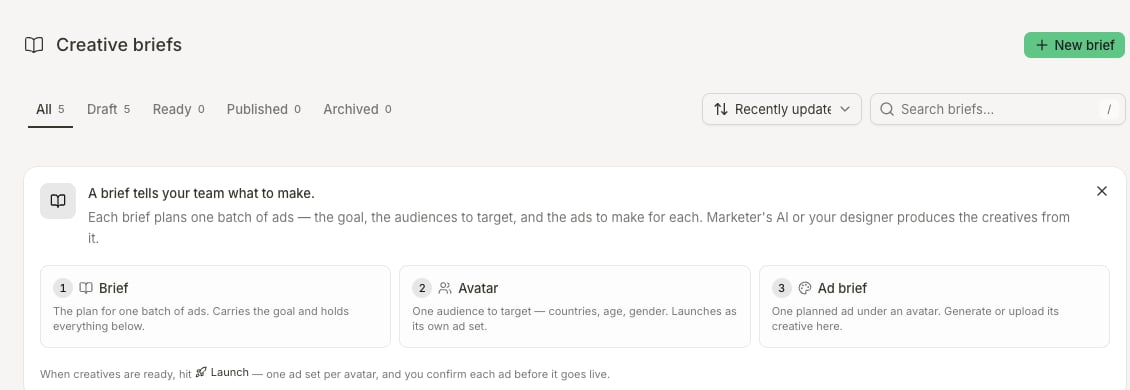
Creative briefs separates the parent Brief, its audience Avatars, and the Ad briefs that hold production direction.
Find and interpret existing briefs
Use the page controls before creating a duplicate:- Tabs: All, Draft, Ready, Published, and Archived, each with its visible count
- Search briefs…
- Sort: Recently updated or Name (A–Z)
Choose Auto or Manual creation
Select New brief, then choose the branch that matches how much strategy is already decided.Auto: develop multiple directions
Use Auto when the product and business request are clear but you still need distinct concepts.1
Choose product context
Select the exact synced catalog product or use the product URL route when offered. Open the destination and confirm product, offer, region, availability, and claims.
2
Complete What’s this brief about?
State objective, audience, offer, evidence, channel, mandatory copy, prohibited claims, and how concepts should differ. A product name by itself is not production direction.
3
Set Concepts
Choose from 1 through 8. Each concept is prepared as a 1:1 and 9:16 pair, so use higher counts only when you need genuinely different angles.
4
Start auto order
Select Start auto order and follow the visible progress. You can close progress and return; the background work remains attached to the brief.
5
Review the result
Open every generated ad brief. Confirm the output did not invent the audience, offer, evidence, claim, or destination.
Manual: preserve an approved direction
Use Manual when strategy is already approved.- Enter Name and Description.
- Use available prompt chips such as Format, Target audience, Tone, or Mandatory copy to make the description executable.
- Select Create brief.
- Reopen the brief and confirm its identity and scope.
Organize Avatars and ad briefs
An Avatar represents the audience a set of ads is intended for. Ads assigned to the same Avatar launch together as an ad set when you use the brief’s Meta handoff. Within a brief:- Open Avatars to inspect the current audience groups.
- Use Persona library to reuse a researched workspace persona when that action appears.
- Create or edit an Avatar when the audience needs brief-specific detail.
- Keep an ad brief under Unassigned until its intended Avatar is known.
- Do not assign one generic Avatar to unrelated audiences merely to clear the unassigned state.
Create an ad brief
Use the add action under the intended Avatar or under Unassigned, then confirm fields such as:- Name
- Funnel stage: TOF, MOF, or BOF
- Format: Image or Video
- Product and destination
- Angle and proof
- Hook, message, mandatory copy, and exclusions
- Any placement or production requirement shown by the editor
Upload and assign existing creative
Use the brief detail’s upload action or drag files into the supported area.- Match each upload to the correct ad brief when possible.
- Files that cannot be matched remain under Unassigned.
- Open the preview and confirm format, aspect, copy, and product identity.
- Link or remove every unassigned file before launch review.
Generate creative from the brief
Choose the narrowest action that matches the work:- Inside one empty ad brief, use its generation action to create only that item.
- At the parent level, choose Generate creatives to generate for ad briefs that do not already have creative.
- Open the resulting work in Studio when you need hands-on refinement.
Launch ads from a brief
Launch ads is a Meta handoff into an existing campaign. It requires:- At least one configured Avatar
- Reviewed creative assigned to the intended ad briefs
- An eligible connected Meta account
- An existing Meta campaign that can receive the new ad sets and ads
1
Open Launch ads
Confirm the brief, product, Avatar groups, and included ad briefs before choosing a campaign.
2
Select the existing campaign
Choose the exact Meta campaign and verify its account, objective, status, budget ownership, and destination assumptions.
3
Review the object mapping
Confirm each Avatar becomes the intended ad set and each linked creative becomes the intended ad. Remove anything that should not launch.
4
Submit and follow progress
Wait for the result to show Launched or Partial launch. A closed dialog or successful parent summary does not prove every ad succeeded.
5
Recover only failed items
For Partial launch, read the per-item failure and retry only the failed work after confirming the successful ads already exist.
6
Verify in Campaigns and Meta
Open the target campaign, inspect parentage, creative, copy, destination, and status, then verify the provider objects in Meta.
Import Airtable CSV when available
Some workspaces expose Import Airtable CSV as a secondary action. If it is absent, do not assume your role or workspace supports the import route. When present:- Drop the Airtable CSV into the import flow.
- Review field mapping and the preview.
- Compare CSV rows, Valid rows, Revisions, and Unchanged counts.
- Select only eligible rows you intend to create or revise.
- Start the import and inspect each resulting brief.
- Retry only the failed brief run rather than importing the entire file again.
Completion check
- The brief is in the correct workspace and grounded in the intended product or URL.
- Objective, audience, offer, evidence, message, format, exclusions, and acceptance criteria are explicit.
- Auto concepts differ strategically and their 1:1/9:16 pairs are expected.
- Every ad brief is saved, assigned intentionally, and linked to the correct creative.
- Unassigned uploads are resolved.
- Launch mapping matches Avatar-to-ad-set and creative-to-ad intent.
- Every launched object reached a terminal result and appears in Meta.
Troubleshooting
Auto creation is generic
Auto creation is generic
Tighten What’s this brief about? with audience, objective, offer, proof, exclusions, and the dimension that should vary across concepts. Use Manual when the decisions already exist.
A product is missing
A product is missing
Confirm Shopify is connected, the source product is active, and the latest product sync completed. Reopen New brief after the record appears in Products.
Generate creatives skips an ad brief
Generate creatives skips an ad brief
Open the ad brief and confirm it is saved, complete, and does not already have linked creative. Use the item-level generation action when only one brief should run.
The result is Partial launch
The result is Partial launch
Inventory successful ads and ad sets first. Read the exact failed item, repair its input, and retry only that failure to avoid duplicate provider objects.
Import Airtable CSV is missing
Import Airtable CSV is missing
The import is not enabled for every workspace. Use New brief or ask a workspace owner whether the feature should be available; do not document it as universal.
Continue
Create and refine in Studio
Carry approved brief context into a persisted concept set.
Track the campaign launch
Verify each provider object and recover from partial publication.