

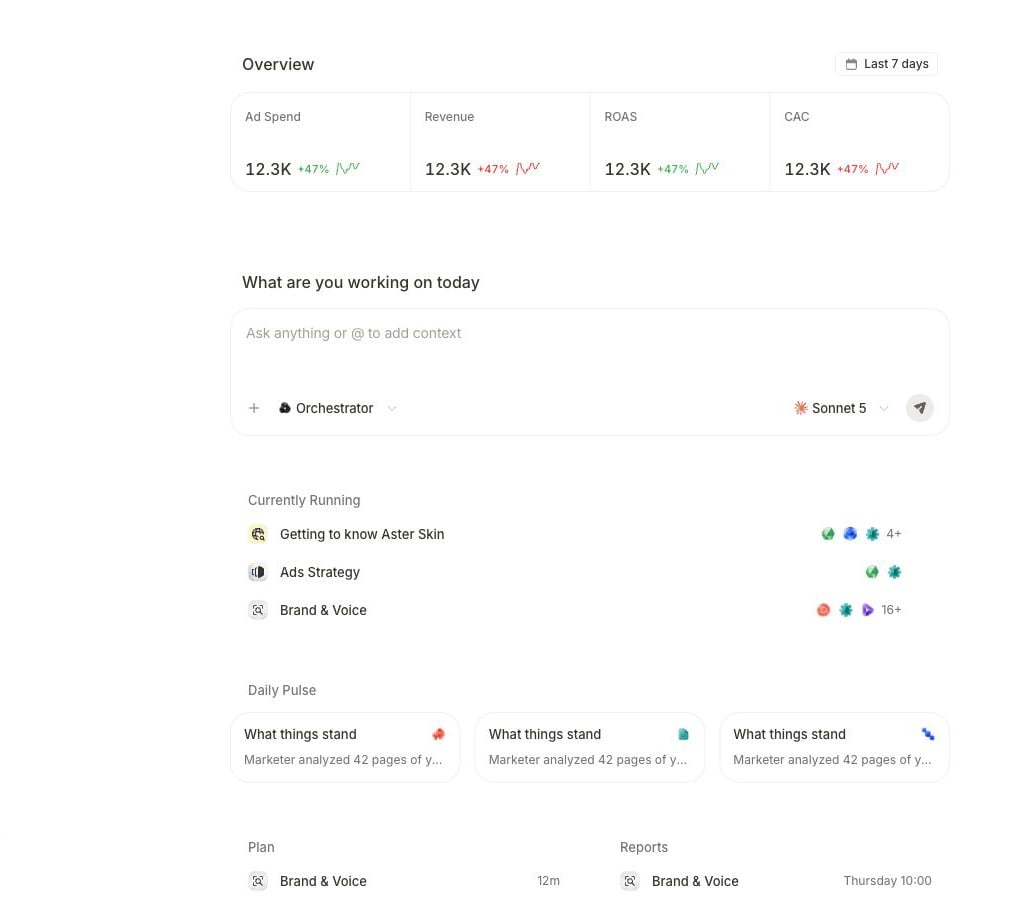
Start in the Home composer, then use the plus control to attach records or use @ to mention an agent.
Start in the right workspace
- Open Home.
- Confirm the workspace name in the upper-left selector.
- Check the date range above Overview if you plan to refer to a metric visible on Home.
- Select the composer labeled Ask anything or @ to add context.
Attach the exact record
Select + on Home. In an existing conversation, select +, then Add context. The picker groups current workspace records under:- All
- Campaigns
- Briefs
- Creatives
- Products
Choose the attachment path
The attachment identifies the record; it does not supply every analytical choice. State the provider, account, date range, attribution view, currency, or comparison you need in the request.
Build the first turn
Write the request in this order so each part can be checked later:- Outcome: what decision or artifact should exist at the end.
- Scope: the attached record, provider, account, channel, or audience.
- Evidence: the sources and metrics the answer must use.
- Window: exact dates or complete-period logic.
- Constraints: facts, guardrails, exclusions, and permitted actions.
- Completion criteria: what a reviewer must be able to see.
Choose Auto or a specialist
On Home, automatic routing appears as Orchestrator. Open the selector to see Auto, described as Routes each request. Keep this route when you want the Marketing Agent to choose the appropriate perspective for each turn. If the menu shows a specialist whose perspective you want to keep, select that specialist before sending. The specialist remains visible in the composer for that conversation. Return to Auto when you want the Marketing Agent to route the next request again. Choosing a specialist changes the perspective applied to the conversation. It does not by itself start a longer task or grant permission to change a connected account.Read the first response state
After you send, the conversation can take one of four paths.Direct answer
The agent answers in the thread without creating longer work. Check the source, dates, scope, and assumptions in the answer. Ask a follow-up in the same thread when it depends on the same attachments and decisions.Clarifying question
Marketer asks for a missing source, record, constraint, or decision. Answer in the current thread so the original context stays attached. If the missing input changes the objective substantially, start a new conversation instead.Proposed agent or pipeline run
Marketer shows the work it wants to perform before starting the longer run. Review the proposal against your original request:- Are the required context-gathering steps present?
- Does the plan produce the requested artifact?
- Does it add a write or generation step you did not request?
- Are important review points or constraints missing?
Waiting for input or approval
A run that already started can pause in Waiting. Open its detail to see whether it needs a conversational answer or a recorded decision. Answer questions in the thread; handle approval items through Awaiting action when that is where the interface routes them.Continue without losing the boundary
Keep the current conversation when the next turn relies on the same record, definitions, or decision. Use follow-ups that name the delta from the prior result:- The objective or deliverable
- The workspace area or provider account
- The authority boundary
- The source-of-truth record
- The intended reviewer or handoff
Review the result in context
When the response or task completes:- Compare the output with the completion criteria in the first turn.
- Confirm that attached records still represent the intended scope.
- Identify the source, account, date range, timezone, currency, attribution view, and freshness behind each decision-driving figure.
- Separate observed facts, interpretations, generated artifacts, and proposed actions.
- Follow output links to the owning surface instead of relying on a chat summary alone.
- If an action is proposed, preserve it as a separate review decision.
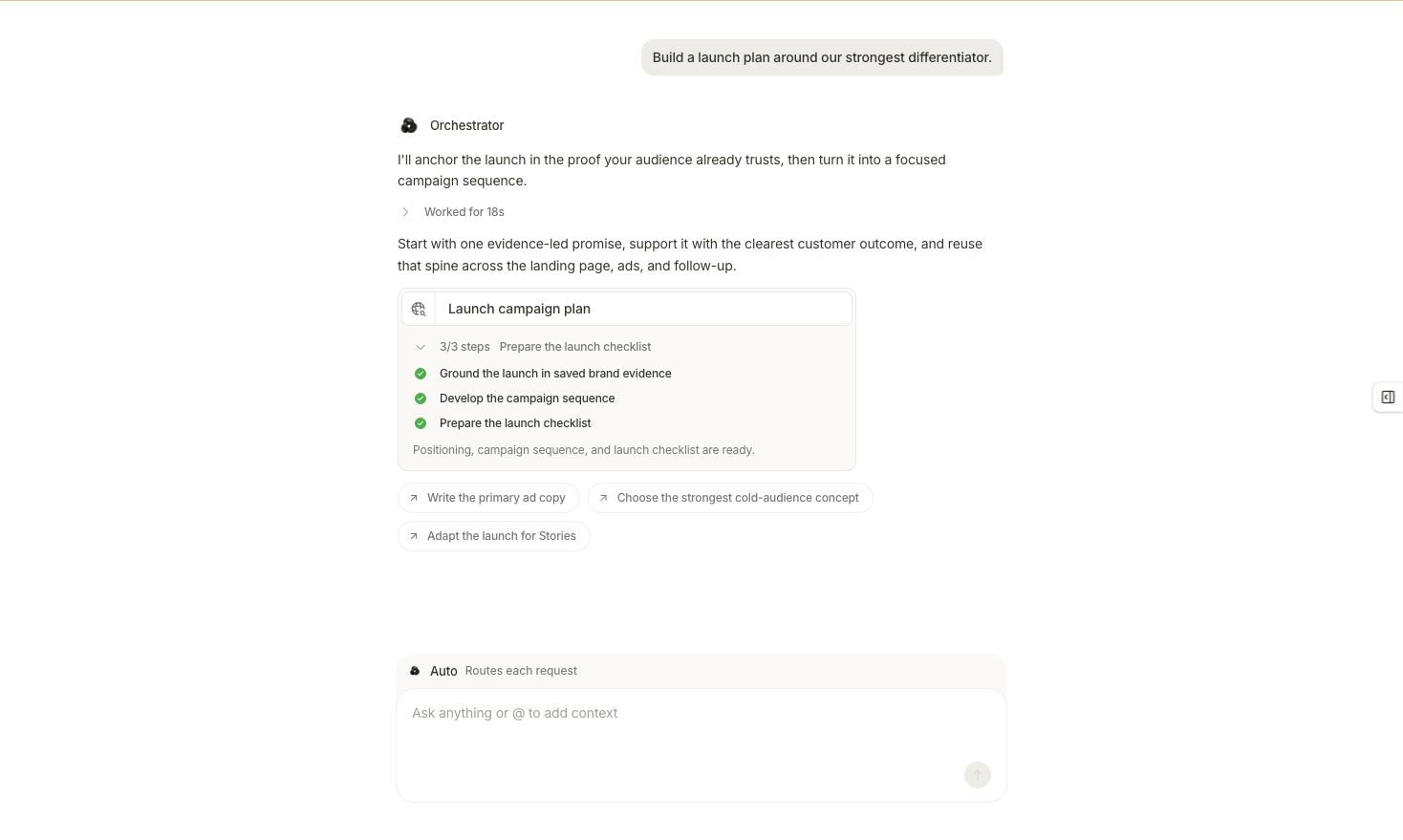
A completed task returns its final step state and focused continuation options to the conversation.
Recover from the wrong path
The wrong record was attached
The wrong record was attached
Do not continue from an answer grounded in the wrong object. Start a clean turn, attach the intended record, and ask Marketer to name it and its provider before analyzing.
The answer is general despite an attachment
The answer is general despite an attachment
Restate the decision, date window, source, metrics, and expected output. An attachment narrows identity; it does not define the full measurement frame.
The proposal contains too much work
The proposal contains too much work
Select Edit and remove unnecessary steps, reduce the output count, or separate research from generation. Approve only the plan you intend to run.
The task became long-running
The task became long-running
Open its task card or Activity. The initial response may acknowledge the request before the full output exists.
An old thread keeps influencing the request
An old thread keeps influencing the request
Start a new conversation and attach only the current records. State the new authority boundary and completion criteria in full.
Next step
Follow the task
Track queued, working, waiting, completed, partial, failed, and canceled work.
Use Home and the composer
See every context, routing, model, file, send, and stop control in place.
Identify the response branch
Move from a direct answer, question, proposal, or task to its correct next action.
Resolve questions and approvals
Answer a waiting run or decide one proposed action.
Inspect specialist work
Open Agents to see who owns each part of coordinated work.
Review a proposed action
Confirm the exact scope and effect before recording a decision.
Reopen a conversation
Open Chats and tasks, then select Chats, when the next turn depends on earlier context.