> ## Documentation Index
> Fetch the complete documentation index at: https://docs.marketer.com/llms.txt
> Use this file to discover all available pages before exploring further.
# Studio
> Seed a Studio session with approved context, generate image or UGC concepts, refine versions, and save or hand off reviewed work.
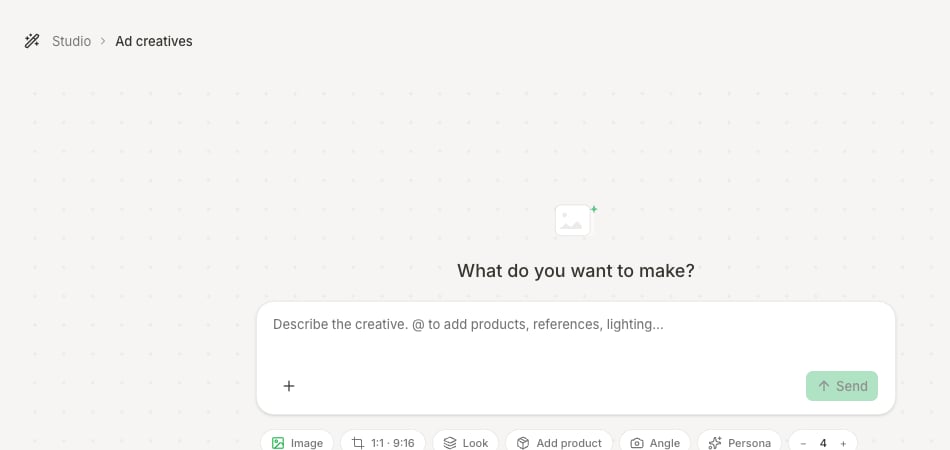
**Studio** is the hands-on creative production surface. It combines a language prompt with explicit product, angle, audience, format, and output controls, then persists generated concepts for later review.
Open [Studio](https://app.marketer.com/dashboard/studio/ads). You can also arrive from a product, ad brief, saved concept, or agent result; always confirm the seeded context before generating.
 ## Read the three working states
| State | What it contains | Correct next action |
| -------------- | -------------------------------------------------------------------------- | ------------------------------------------------- |
| Composer | Prompt, attachments, product, angle, Avatar, type, format, look, and count | Verify scope, then generate |
| Results | Persisted concept gallery for one generation | Compare outputs and open the strongest candidates |
| Concept detail | Selected version, formats, edits, and save/use actions | Refine, review, and choose a destination |
Generated concepts persist after completion. Unsaved prompt text and attachments in a fresh composer can be lost if you accept the close warning.
## Confirm seeded context
When Studio opens from another surface, inspect:
* Product attachment and source image
* Ad brief or angle
* Avatar or persona
* Reference images
* Format and concept type
* Prompt text and exclusions
Remove wrong or stale context before adding more. A correct product attachment establishes identity, but it does not automatically supply the audience, offer, evidence, or creative strategy.
## Compose a focused generation
Select the available image or UGC/video route that matches the requested deliverable. The controls below can change with the selected type.
Select **Story 9:16**, **Square 1:1**, or **Feed 4:5** as required. Generate distinct placement formats when composition needs to change; a crop is not always a safe adaptation.
Select the visual treatment that supports the brief. Treat it as direction, not permission to override product or brand facts.
Choose the exact product and audience. Confirm the angle is supported by approved evidence and relevant to that Avatar.
Type `@` to add available **References**, **Products**, **Avoid**, **Angle**, or **Avatar** context. State which reference is factual, which is visual inspiration, and what must be avoided.
Choose 1 through 8. More outputs help only when the prompt states how they should differ.
Name the audience insight, single promise, proof, product presentation, composition, mandatory copy, exclusions, and acceptance criteria.
If a product handoff exceeds Studio's attachment limit, Marketer states how many products were attached. Add any remaining intended product from the composer and remove products that do not belong in this generation.
## Use the UGC branch
When **Type** is UGC, review the additional controls the composer exposes, such as:
* Script or talking points
* Voice style
* Product
* Actor or persona
* Output format
Confirm that the script does not present an invented testimonial, unsupported personal experience, or prohibited claim. The actor and voice establish presentation; they do not create evidence.
## Generate and compare results
1. Start generation and wait for the result set to appear.
2. Confirm the result page identifies **Studio** and the intended generation.
3. Compare product accuracy, message hierarchy, brand fit, differentiation, legibility, and placement fit.
4. Open each serious candidate in concept detail.
5. Switch among generated versions or formats without confusing them.
6. Reject outputs that require a new premise, not just a visual correction.
Use **Recent drafts** from the composer home to reopen a persisted result. If a generation still runs, let its state resolve instead of starting duplicate work from the same prompt.
## Refine a concept
Concept detail can expose editing areas such as:
* **Overview**
* **Refine**
* **Relight**
* **Angles**
* **Color**
* **Background**
* **Enhance**
* **Upscale**
* **Overlays**
* **Text**
Select the intended edit, write a precise instruction, review what will remain fixed, and choose **Edit**. Stack edits deliberately and reopen prior versions when a later edit damages an approved element.
**Overlays** and **Text** are creative-edit instructions in the current flow, not a promise of independently editable design layers. Verify the rendered result itself.
Concept detail can also support previous/next navigation, zoom, format or version switching, download, rename, and delete. Confirm the selected version before destructive or destination actions.
## Save or use approved work
Use **Save or use** to choose the intended next state:
* **Save to creative library** preserves the reviewed concept in **Creative Assets**.
* **Add to campaign** or **Use in campaign** opens a campaign handoff; it does not launch the ad.
After saving, find the result in [Creative Assets](/product-guides/creatives-assets) and confirm format, visual, and identity. After a campaign handoff, inspect the exact ad's creative, copy, destination, and review state before publication.
## Completion check
* The active workspace and source context are correct.
* Product, angle, Avatar, references, and Avoid context were inspected before generation.
* Type, format, look, count, and prompt match the brief.
* Every candidate was reviewed for product facts, claims, brand fit, legibility, and placement.
* Refined versions preserve approved elements and correct only the intended issue.
* The exact final version was saved or handed to a campaign.
* Creative Assets or the campaign draft shows the expected result.
## Troubleshooting
Inspect **Product** and every `@` attachment. Remove the wrong item, attach the exact synced record, and regenerate only after the context row is correct.
State a different audience insight, angle, proof, or visual system for each option while keeping the product and objective stable. Raising **Count** alone usually creates near-duplicates.
Open **Recent drafts** and identify the persisted generation. Unsaved composer text can be lost, but completed concept sets should be reopened from their saved result.
Return to the prior version, tighten the instruction to preserve approved product, copy, and composition, then apply only the necessary correction.
Confirm the save completed, then clear Creative Assets search and filters and choose the expected format. Reopen the Studio concept if the destination action is still pending or failed.
Stop in the campaign draft, return to the exact Studio version, and repeat the handoff once. Confirm the ad preview before continuing to Review.
## Continue
Verify the saved file, labels, usage, and linked ad states.
Correct strategy at the source when the concept has the wrong premise.
## Related topics
- [Catalog, product detail, and image enhancement](/product-guides/products-catalog-and-enhancement.md)
- [Products](/product-guides/products.md)
- [Creatives](/product-guides/creatives.md)
- [Creative Briefs](/product-guides/creatives-briefs.md)
- [Knowledge and Skills](/product-guides/knowledge-and-skills.md)
## Read the three working states
| State | What it contains | Correct next action |
| -------------- | -------------------------------------------------------------------------- | ------------------------------------------------- |
| Composer | Prompt, attachments, product, angle, Avatar, type, format, look, and count | Verify scope, then generate |
| Results | Persisted concept gallery for one generation | Compare outputs and open the strongest candidates |
| Concept detail | Selected version, formats, edits, and save/use actions | Refine, review, and choose a destination |
Generated concepts persist after completion. Unsaved prompt text and attachments in a fresh composer can be lost if you accept the close warning.
## Confirm seeded context
When Studio opens from another surface, inspect:
* Product attachment and source image
* Ad brief or angle
* Avatar or persona
* Reference images
* Format and concept type
* Prompt text and exclusions
Remove wrong or stale context before adding more. A correct product attachment establishes identity, but it does not automatically supply the audience, offer, evidence, or creative strategy.
## Compose a focused generation
Select the available image or UGC/video route that matches the requested deliverable. The controls below can change with the selected type.
Select **Story 9:16**, **Square 1:1**, or **Feed 4:5** as required. Generate distinct placement formats when composition needs to change; a crop is not always a safe adaptation.
Select the visual treatment that supports the brief. Treat it as direction, not permission to override product or brand facts.
Choose the exact product and audience. Confirm the angle is supported by approved evidence and relevant to that Avatar.
Type `@` to add available **References**, **Products**, **Avoid**, **Angle**, or **Avatar** context. State which reference is factual, which is visual inspiration, and what must be avoided.
Choose 1 through 8. More outputs help only when the prompt states how they should differ.
Name the audience insight, single promise, proof, product presentation, composition, mandatory copy, exclusions, and acceptance criteria.
If a product handoff exceeds Studio's attachment limit, Marketer states how many products were attached. Add any remaining intended product from the composer and remove products that do not belong in this generation.
## Use the UGC branch
When **Type** is UGC, review the additional controls the composer exposes, such as:
* Script or talking points
* Voice style
* Product
* Actor or persona
* Output format
Confirm that the script does not present an invented testimonial, unsupported personal experience, or prohibited claim. The actor and voice establish presentation; they do not create evidence.
## Generate and compare results
1. Start generation and wait for the result set to appear.
2. Confirm the result page identifies **Studio** and the intended generation.
3. Compare product accuracy, message hierarchy, brand fit, differentiation, legibility, and placement fit.
4. Open each serious candidate in concept detail.
5. Switch among generated versions or formats without confusing them.
6. Reject outputs that require a new premise, not just a visual correction.
Use **Recent drafts** from the composer home to reopen a persisted result. If a generation still runs, let its state resolve instead of starting duplicate work from the same prompt.
## Refine a concept
Concept detail can expose editing areas such as:
* **Overview**
* **Refine**
* **Relight**
* **Angles**
* **Color**
* **Background**
* **Enhance**
* **Upscale**
* **Overlays**
* **Text**
Select the intended edit, write a precise instruction, review what will remain fixed, and choose **Edit**. Stack edits deliberately and reopen prior versions when a later edit damages an approved element.
**Overlays** and **Text** are creative-edit instructions in the current flow, not a promise of independently editable design layers. Verify the rendered result itself.
Concept detail can also support previous/next navigation, zoom, format or version switching, download, rename, and delete. Confirm the selected version before destructive or destination actions.
## Save or use approved work
Use **Save or use** to choose the intended next state:
* **Save to creative library** preserves the reviewed concept in **Creative Assets**.
* **Add to campaign** or **Use in campaign** opens a campaign handoff; it does not launch the ad.
After saving, find the result in [Creative Assets](/product-guides/creatives-assets) and confirm format, visual, and identity. After a campaign handoff, inspect the exact ad's creative, copy, destination, and review state before publication.
## Completion check
* The active workspace and source context are correct.
* Product, angle, Avatar, references, and Avoid context were inspected before generation.
* Type, format, look, count, and prompt match the brief.
* Every candidate was reviewed for product facts, claims, brand fit, legibility, and placement.
* Refined versions preserve approved elements and correct only the intended issue.
* The exact final version was saved or handed to a campaign.
* Creative Assets or the campaign draft shows the expected result.
## Troubleshooting
Inspect **Product** and every `@` attachment. Remove the wrong item, attach the exact synced record, and regenerate only after the context row is correct.
State a different audience insight, angle, proof, or visual system for each option while keeping the product and objective stable. Raising **Count** alone usually creates near-duplicates.
Open **Recent drafts** and identify the persisted generation. Unsaved composer text can be lost, but completed concept sets should be reopened from their saved result.
Return to the prior version, tighten the instruction to preserve approved product, copy, and composition, then apply only the necessary correction.
Confirm the save completed, then clear Creative Assets search and filters and choose the expected format. Reopen the Studio concept if the destination action is still pending or failed.
Stop in the campaign draft, return to the exact Studio version, and repeat the handoff once. Confirm the ad preview before continuing to Review.
## Continue
Verify the saved file, labels, usage, and linked ad states.
Correct strategy at the source when the concept has the wrong premise.
## Related topics
- [Catalog, product detail, and image enhancement](/product-guides/products-catalog-and-enhancement.md)
- [Products](/product-guides/products.md)
- [Creatives](/product-guides/creatives.md)
- [Creative Briefs](/product-guides/creatives-briefs.md)
- [Knowledge and Skills](/product-guides/knowledge-and-skills.md)